

By Kenneth Posner, CFO, Sagent
Back in the year 2000, I predicted that servicing would become the “strategic high ground” for the mortgage industry. My reasoning was that servicing is a scale business with significant entry barriers and that servicers would become increasingly skilled at capturing refinances and new home purchases, allowing them to control a growing share of the originations market.i Now, in the spirit of full disclosure, as a young research analyst, I had no special insights – I was merely listening to the industry’s thought leaders of the time. As it turned out, their foresight was quite good.
Today, industry players clearly recognize the strategic importance of servicing. Thanks to its acquisition acumen and an efficient platform, Mr. Cooper became the market’s largest servicer, making it the perfect partner for Rocket Mortgage in its quest to create the industry’s first integrated homeownership platform. RITM grew its servicing portfolio through acquisitions of Caliber and SPS, Bayview acquired Guild Mortgage, PennyMac bought Cenlar, and Cross Country Mortgage won the bidding war for Two Harbors, while UWMC made the decision to take servicing in house and recapitalize its balance sheet to support further asset growth.
However, while consolidation has brought efficiencies to a handful of scale players, at the same time, for the industry as a whole, servicing costs have been rising, not falling. Which is not the trend you’d expect to see in any sector of the financial services industry today. To be specific, according to the MBA’s Servicing Operations Study and Forum, direct servicing cost per loan rose from $181 in 2024 to $185 in 2025. Since 2019, this all-important efficiency metric is up a whopping 29%.
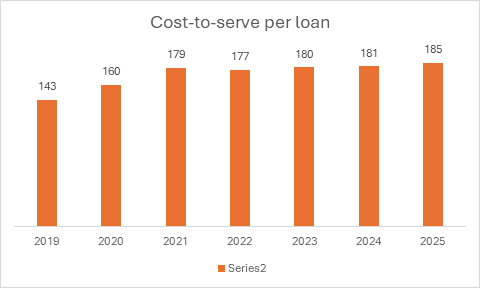
Direct servicing expense, excluding unreimbursed FC, REO, and other costs and allocated corporate overhead. Source: MBA Servicing Operations Forum and Study
Now, as a caveat, the MBA data is based on a peer study, and the overall results may be skewed by the mix of operators participating in their forum. Nonetheless, based on what I hear from customers and colleagues, there are clearly several trends driving higher costs – and greater operational pain – for servicers today:
- First is the rising complexity of law and regulations, including not only federal regulators and agencies like Fannie Mae and Freddie Mac, which are shifting to an event-driven reporting regime, but also changes in state law in places like California and Washington State, which layer on additional requirements. My colleague, Matt Tully, recently pointed out that there are some 8,800 different rules that a servicer could be expected to comply with today.ii The cost of reconciliations and audits has become a heavy burden, not to mention constant change management.
- Another cause of higher costs and greater pain is the fact that customer expectations are rising. After all, when it comes to other products like credit cards, deposit accounts, and trading, consumers are used to accessing real-time data on their laptops and phones, and if they need to call someone for extra help, they expect well-trained, empathetic agents with answers to every question at their fingertips. Mortgage servicers are being forced to catch up, and they’re scrambling.
- Servicers got a reprieve during the pandemic from the costs of managing delinquencies, when forbearance programs were made available as part of the CARES Act. Since then, however, government programs have been tightened up, and non-performers have started to inch up in certain areas. With the direct servicing expense for non-performers easily 10x that of performing loans, even small shifts in credit quality pose significant challenges. A full-fledged cycle could pose existential threats to many operators.
- Finally, servicing remains highly labor intensive, with personnel costs making up 75% of total expense in many shops. As a result, in today’s environment, inflationary-driven pressure on wages and benefits contributes to rising costs, especially with respect to workers with valuable technology skills.
For all of these trends, there’s a single root cause for pain and profit pressure — most operators still depend upon legacy tech platforms tied to mainframe systems. The 24-hour batch processing cycles necessitated by these ancient applications are painfully slow. This frustrates consumer expectations for speedy service and forces them to make multiple calls to get issues resolved. Errors creep in and propagate between cycles, creating expensive rework and Quality Assurance problems and slowing down agentic tools. New features take forever to get to market. As a result of these complexities, mortgage servicing has lagged well behind the rest of the financial services industry in terms of realizing the amazing benefits of modern technology.
A modern tech stack would solve these problems. The standards are well understood: systems must be cloud-native and AI-ready and written in modern languages where change-management can be done in days or weeks instead of months. The stack needs to be built upon a unified database with separate OLAP layers to prevent queries and analytics from slowing down real-time transaction processing. Compliance-as-code means that those 8,800 rules (and growing every day) are recognized and embedded into a real-time engine that speeds up change management. Modern systems are modular, using APIs for plug and play, but concentrating functionality in the core to maximize speed and efficiency. For control and compliance purposes, all actions are captured in an immutable audit trail. Intuitive user interfaces make training much easier and facilitate development of workflows that create the operator’s true “secret sauce.”
According to McKinsey, a modern servicing system could provide up to 40% savings in cost-to-serve for companies ready to migrate from legacy applications. Now to be sure, those savings won’t drop into your lap when the system is first turned on – rather, mortgage operators will need to reengineer processes to take advantage of new capabilities.
So, it will take some work to get there, but these kinds of efficiency gains are especially critical for small and medium-sized companies, which typically pursue niche strategies. According to the MBA, performing loan cost-to-serve for medium IMBs was $231 in 2024, almost double the $127 reported by large IMBs. 40% in savings from a new system would bring medium IMBs close to parity with larger peers. For large operators competing aggressively across multiple aggregation channels, a modern stack could make the difference between growing market share and stagnation.
The good news is that multiple vendors, including Sagent, now offer modern servicing technology platforms, but make no mistake – these technologies are poised to disrupt the mortgage industry’s status quo. We may well see a new generation of markets leaders emerging from among those who can figure out how to implement modern technology.